“We had hoped there would be photovoltaics, and we do believe in photovoltaics,” Lewis says. “But the return on investment, which is a measure that developers and builders use, just has not gotten there. It’s gotten closer, much closer, but energy costs haven’t gone up that quickly, and the cost of these systems hasn’t come down enough.”
However, One World Trade Center will have elevators with regenerative braking, meaning that the kinetic energy generated by the brakes as they operate will be used or stored.

Managing director Kenneth Lewis of Skidmore, Owings & Merrill.
“We hear about regenerative braking in the Toyota Prius,” Lewis explains. “It’s actually been in elevators for a while, but the technology just keeps getting better and better.”
Overall, One World Trade Center’s energy performance will exceed building code requirements by 30 percent, architects say. Besides contemplating ways for the tower to generate its own energy, architects also considered methods of making the building more energy efficient by reducing energy consumption. To that end, the tower will have a co-gen, or combined heat and power unit, whose excess heat is captured and used as it generates electricity.
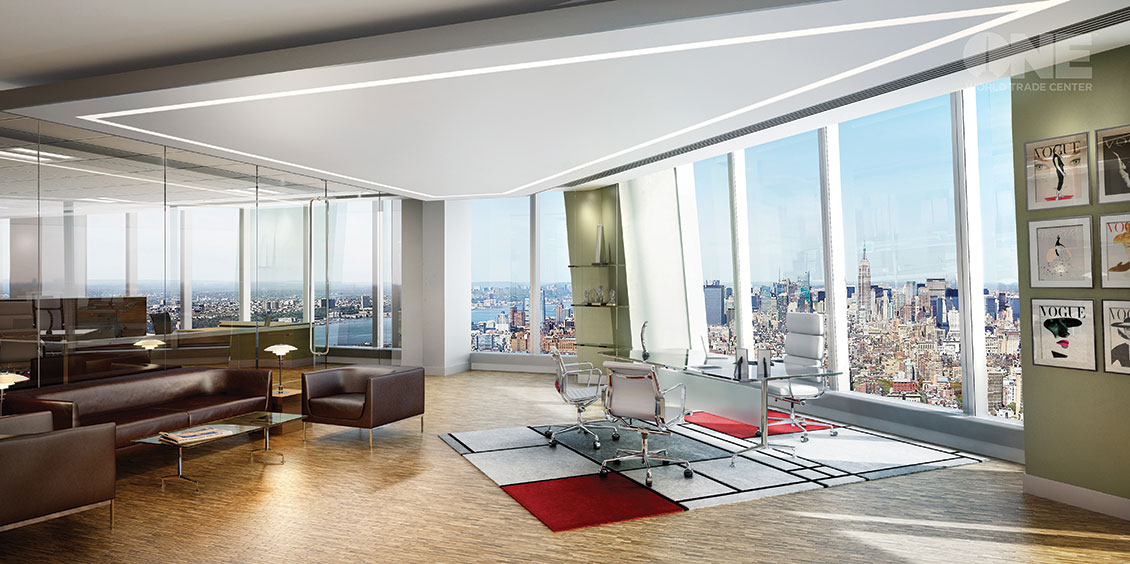
One of the biggest innovations in the tower to reduce energy usage is oversized panels of low-iron glass in the curtain wall that are at once strong, secure, and allow maximum daylighting in the building’s interiors. Daylighting means that on sunny days, light-dimming devices kick in to save energy. The glass panels, which are approximately 5 x 13-1/2 feet and were designed by architects working with industry experts, span the full floor height with no mullions, reducing the amount of aluminum used and achieving 90 percent daylight on the floors.
“We really believe that by maximizing daylight, you not only reduce the amount of lighting that people use, but also people’s general well-being increases,” Lewis says.
Another important quality of the glass panels is a low-emissivity coating that reflects the heat of solar radiation, keeping the tower from cooking on torrid summer days and reducing the energy needed for cooling. The tower uses low-energy appliances, the most important ones being variable-speed fans and pumps.
“The bulk of the spaces will use variable-speed fans because sometimes you just don’t need as much air, for instance at night,” he says. “So it’s based on occupancy.”
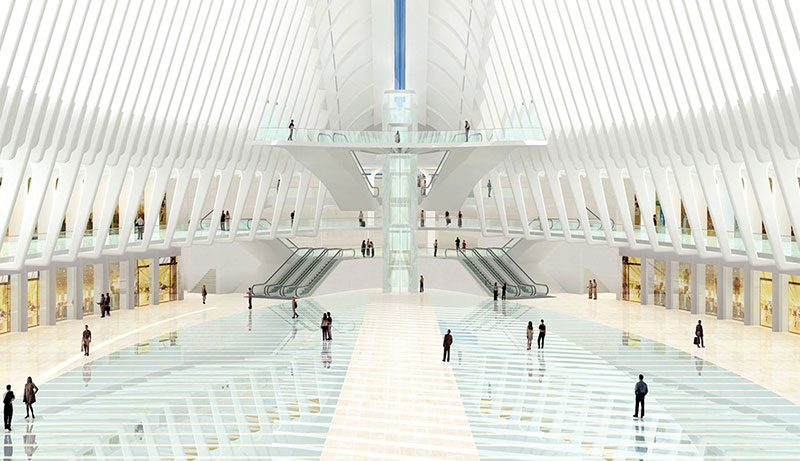
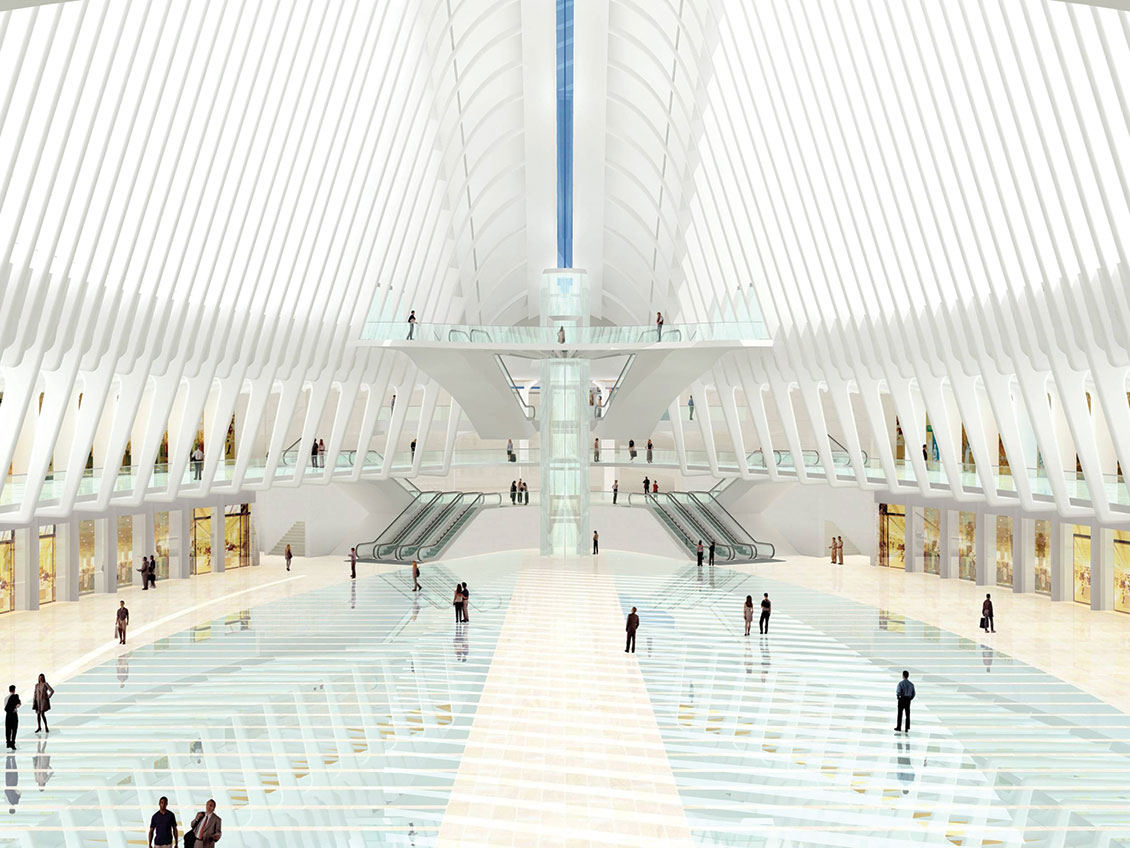
The west concourse of the World Trade Center opened this year.
Part of the tower’s challenge was its lengthy development process of over a decade, but architects were also able to use that to their advantage. At the start of the process, energy-efficient LED lighting didn’t seem plausible, but with evolutions in technology, the lights are now affordable enough to outfit almost the entire tower with them—even the beacon.
“The beacon is a great story of industry catching up with us, so instead of xenon lamps, which are incredibly high-energy users, the ones you see in Vegas and Memphis, we can now use LED lights after some brilliant guys in Boston came up with a way to embed them in cylindrical plastic,” Lewis says.
Another focus of energy reduction is the tenancy in the tower, which will have over 9,000 people in it on a daily basis. A state-of-the-art building management system, will be used by the Durst Organization, which will run the building. Thousands of “data points” throughout the tower will monitor indoor air quality and energy usage. Lewis points to experiments showing that when an energy meter is installed in a home to record energy use, the home’s owner tends to become more energy conservative.
“Every single tenant in One World Trade Center will have their own meter, so they can see how much energy they’re using,” he says, and tenants will, of course, be billed accordingly.
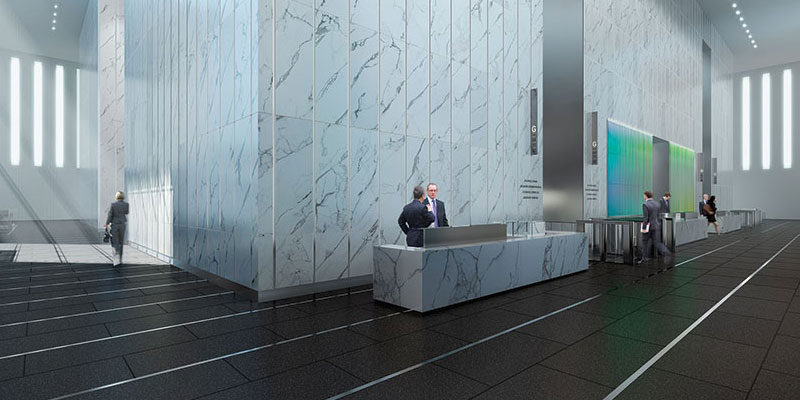
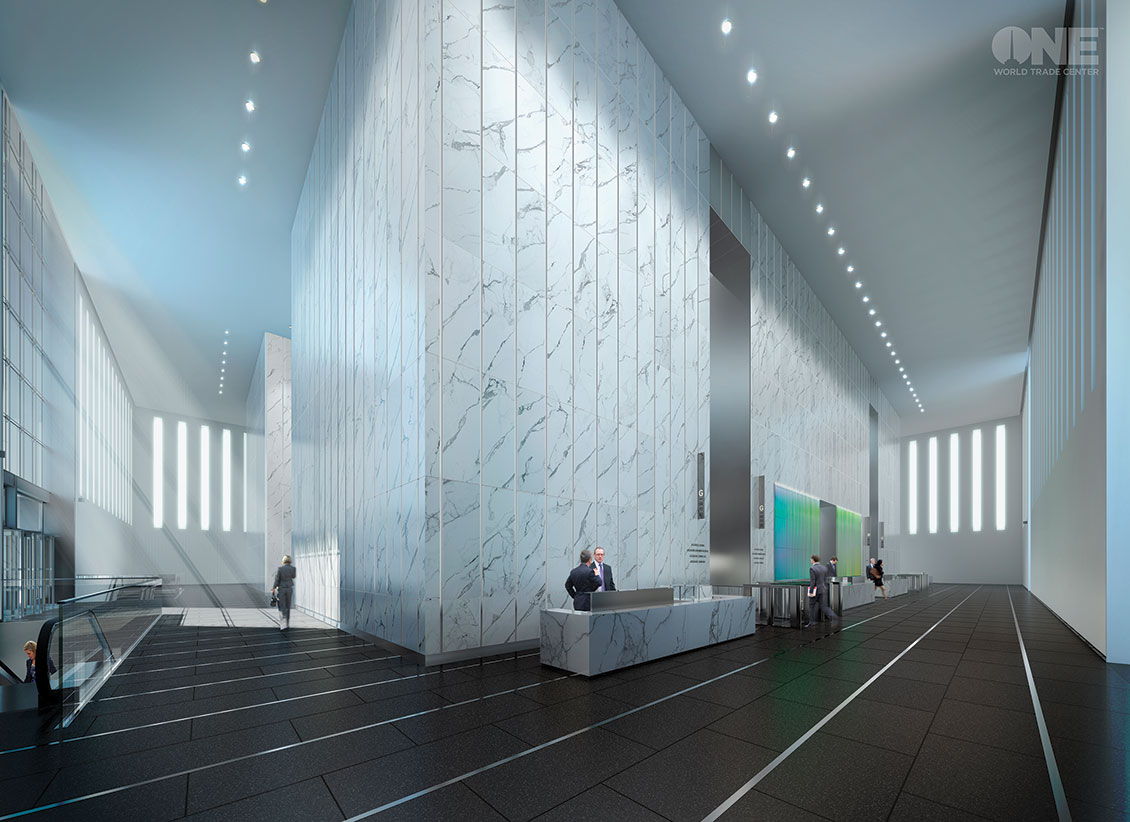
The marble lobby is sheltered with concrete walls more than two feet thick. The concrete is slotted to allow daylight into the space.
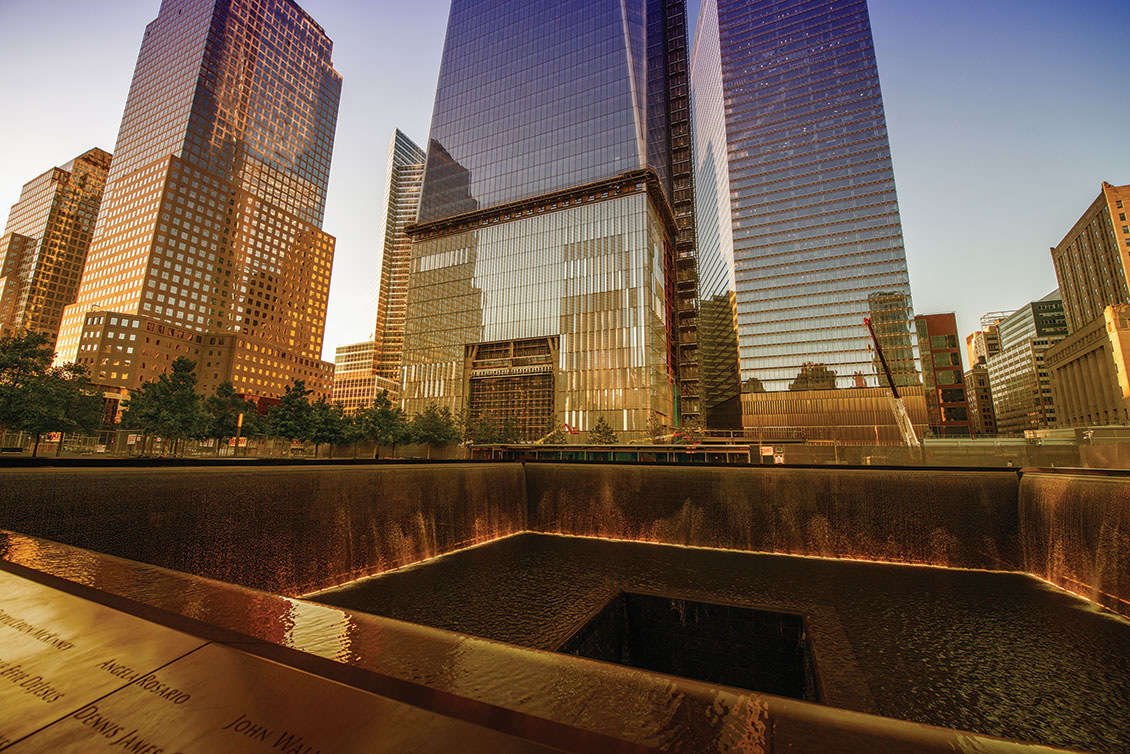
Besides its many features meant to minimize energy consumption, One World Trade Center also incorporates a host of other sustainability strategies. For example, water conservation is important, and all plumbing fittings are low-flow. Also, the tower and each of the buildings at the World Trade Center site has its own system of tanks for capturing and storing rainwater to be used for cooling purposes as well as fire protection and irrigation. The large, square reflecting pools marking the footprint of the original twin towers are, in fact, used for rainwater collection. As well, One World Trade Center’s half-acre of plaza uses xeriscape, or water-conserving landscaping, to reduce water usage. Plants, such as purple lovegrass, fragrant sumac, and prairie dropseed, will be spray- and drip-irrigated. “That reduces the amount of water that is lost into the sediment and just sort of sits there,” Lewis says.
The materials in One World Trade Center were also critical regarding its sustainability mission. For instance, the building used so-called “green concrete,” with coal fly ash, which architects had to go back to the lab to develop while also trying at the same time to almost triple the concrete’s strength, Lewis says. This “liquid steel”
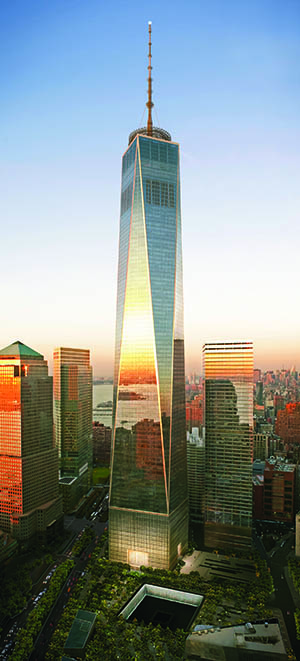
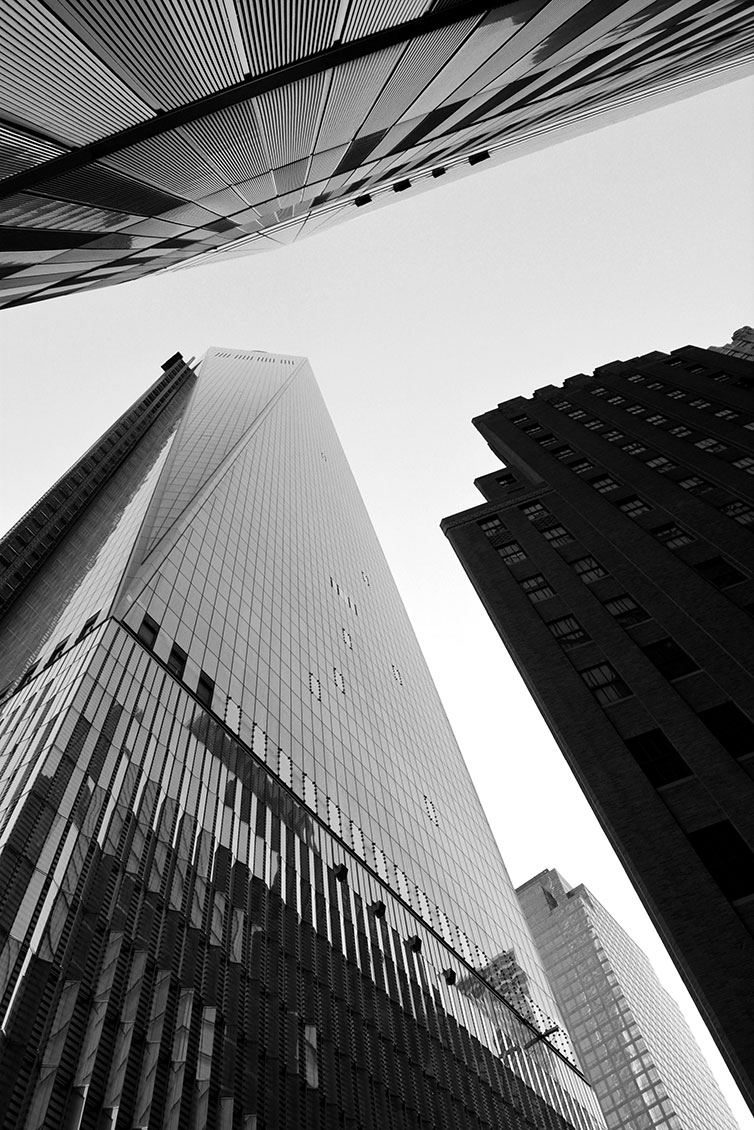
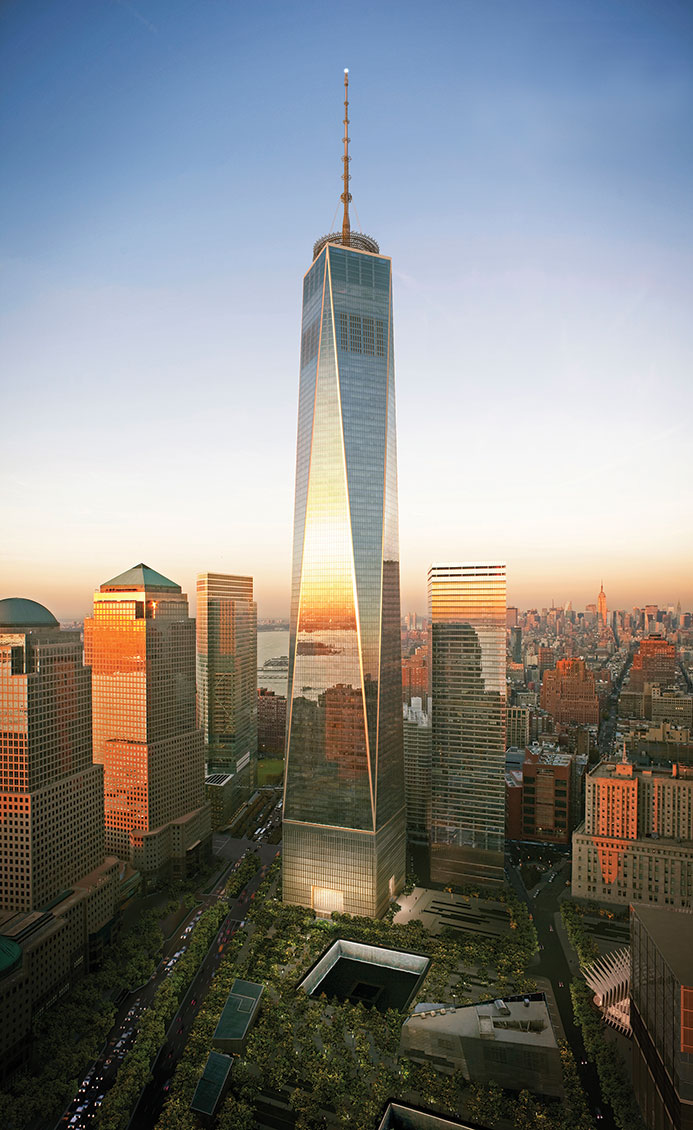
Eight interlocking triangles create the façade of one World Trade Center. Steelworkers used recycled cars and refrigerators in the construction of the building. The 22-ton spire topping the super-tall structure acts as an LED beacon of light and can be seen for miles.
was then used for the building’s core. Many of the other materials in the building, from gypsum boards to ceiling tiles to glass, are made from post-industrial recycled content. “When you use recycled materials, you’re not releasing more carbon into the atmosphere, and you’re using less energy to produce the material,” Lewis says.
Any materials containing volatile organic compounds (VOCs) that leach from materials and cause health problems were banned; and most wood and wood products were certified by the Forest Stewardship Council, which means they came from responsible sources and not endangered trees or forests.
Because the construction process can be as potent a source of environmental impact as the finished building, especially to neighbors, many sustainable practices were incorporated into the construction site, Lewis says. A recycling program was set up, and most of the construction waste at the site has been recycled, with very little going into landfills. Steel workers used composting toilets while they were on site.
One area benefited in particular from public input on the project. The architects were approached by two nonprofit groups, Clean Air Communities and Northeast States Center for a Clean Air Future, at the beginning of the project to discuss the city’s asthma epidemic and suggest the use of ultra low-sulfur fuels in fixed onsite equipment and trucks to reduce nitrogen oxide and particular emissions in the air of the surrounding community.
“There’s a sense that the asthma epidemic in New York was due to all the particulate matter that was floating around, the regular diesel fuel, construction waste, and just the detritus of society, so we decided to do our part in reducing that,” Lewis says.
At the time, there was only one supplier of the fuel, located in New Jersey, so the two groups and the Port Authority funded a pumping station at the World Trade Center site. Still, construction companies were worried that the fuel might damage their machines or the machines wouldn’t be able to generate enough horsepower, so it was very much an experiment, Lewis says.
“Now, it’s anecdotal, but we’re hearing that their machines are actually lasting longer with this low-sulfur fuel,” he says. “Everybody brings ideas to the table, and this was a great one.”
Because the World Trade Center site has access to 12 subway lines, about 90 percent of its tenants, workers, and visitors will arrive via public transportation, disembarking at the site’s new transportation hub. Tenants and workers may also be given incentives to commute by bicycle or carpool, while the site will also have outlets to plug in electric vehicles, so transportation is another “monster green feature” of One World Trade Center, Lewis says.
While One World Trade Center hasn’t yet earned LEED-certification, architects, who will finish up their part in the building this spring, are working on the process. Lewis says he anticipates certification sometime around October: “We want to open it up and have the LEED plaque on the door.”