Right: Megan Zanella-Litke, American University’s sustainability director.
Georgetown’s Stewart says that, while “it’s hard to draw a line” between the signing of the pledge and specific university initiatives, the commitment has increased awareness of the school’s shared goals with other colleges and with the District itself. “The pledge gave us a more coherent framework to collaborate as a sector and to collaborate with our local city government,” explains Stewart. “I think it helped us become more aware of local sustainability priorities and how we could align with them.” For example, she says, the university is working to contribute to the District’s efforts surrounding stormwater runoff reduction. “In our new construction, we’re being really intentional about more effectively managing stormwater.”
George Washington’s Chapple says that the pledge “helped build a bridge” between universities and the D.C. government. “If we had a question or a problem around putting solar on rooftops because of a height restriction, the pledge gave us access to people who
could help us navigate that quagmire,” she says. In addition, she continues, the pledge keeps sustainability issues on the radar of university presidents and other top-level leaders. “I think it helps the leaders at a university see how they are performing alongside their peers in terms of sustainability on campus. It definitely creates a buzz, and it highlights things that people can be proud of.”
Chapple also credits the pledge with paving the path to a large joint purchase of renewable energy with American University. The partnership between the two schools, plus the George Washington University Hospital, will help the school derive more than half of all its electricity from solar power. In total, it will result in the purchase of 123 million kilowatt hours (kWh) of emissions-free electricity per year drawn from 243,000 solar panels at three sites—the equivalent of taking 12,500 cars off the road. Now, other D.C. universities are considering teaming up for similar renewable energy purchases.
“Having this group, this collective, really helped facilitate that joint purchase,” says Chapple. “We went out to bid together. We designed the scope for a large-scale renewable energy project together, because we wanted to maximize the scope of our joint purchasing power. Because we had this group, and because we had this access to the city government, we could start talking about creative solutions to climate change.”
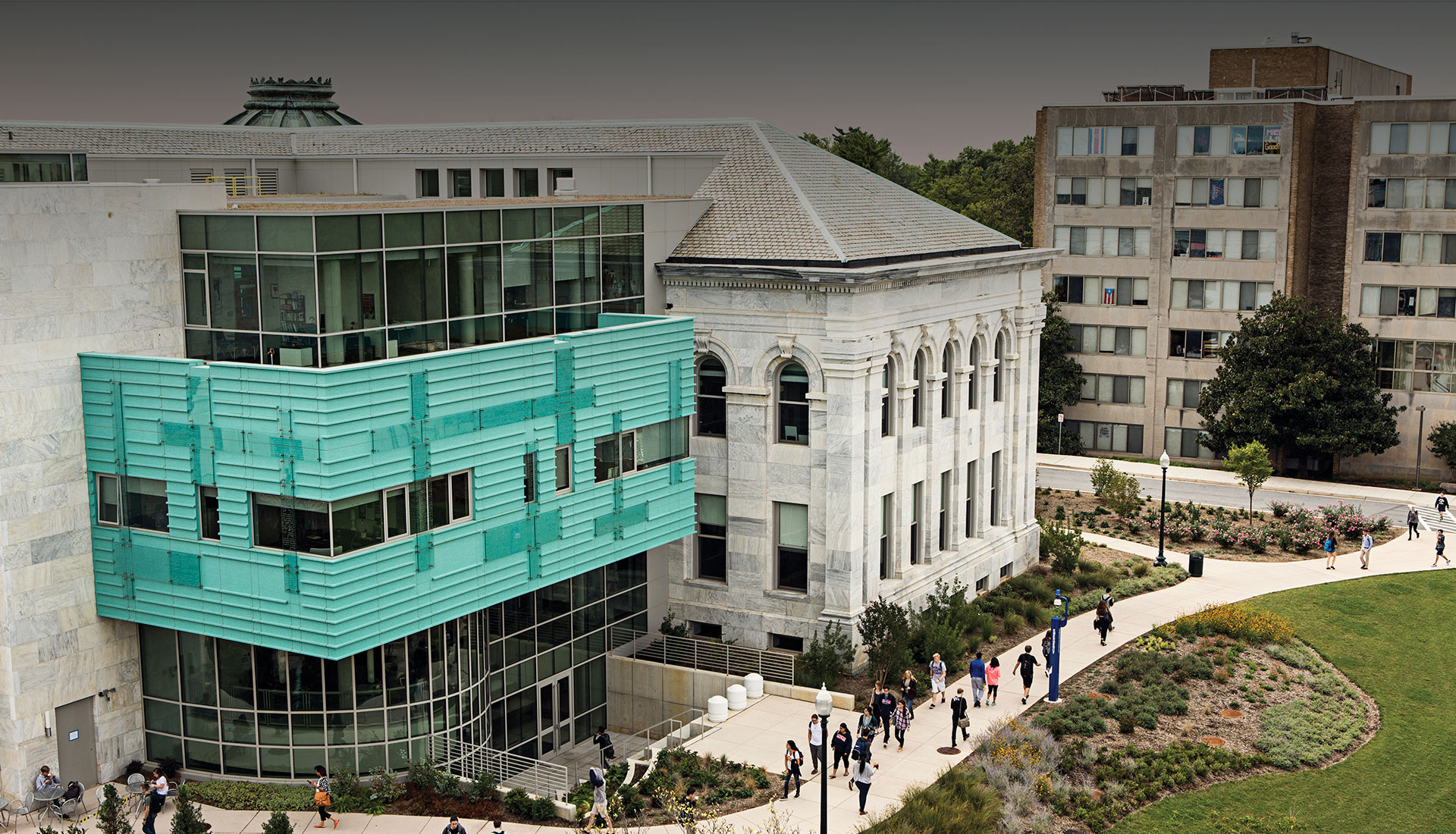
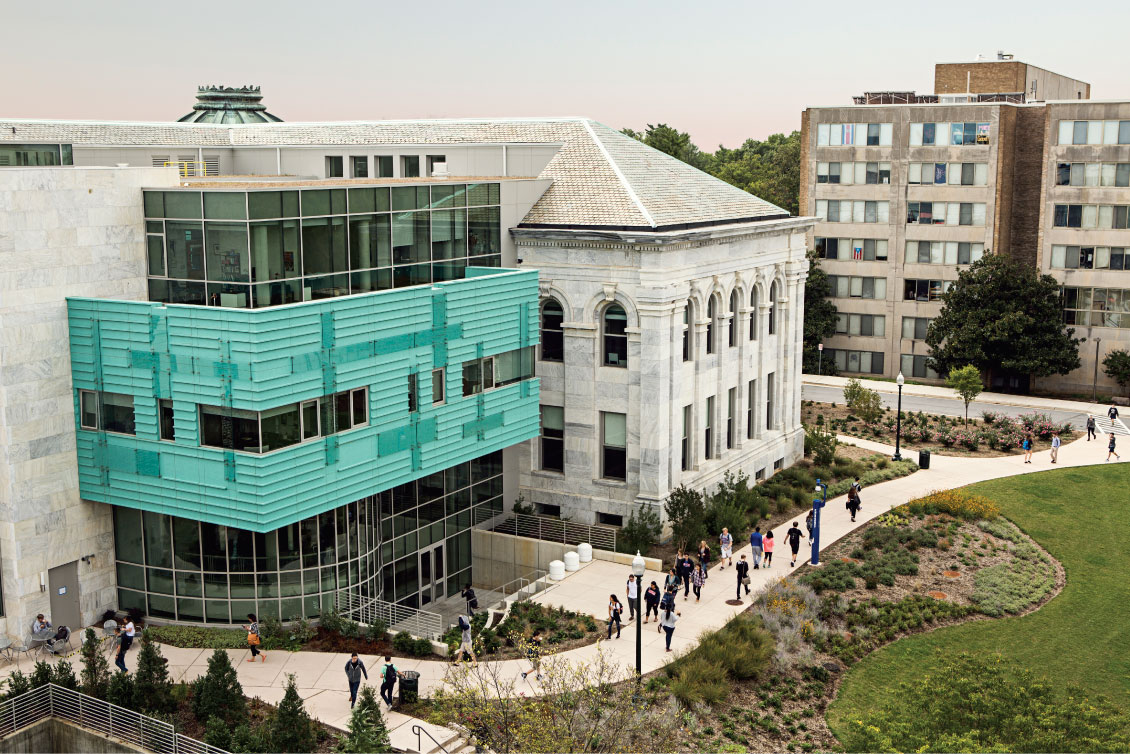
If any D.C. university would have been fine going it alone, it is American University. The school has a well-deserved national reputation as a sustainability leader, and alone it accounts for more than 3 million of the approximately 8.7 million square feet of higher education LEED certified and registered space in the district. It is also one of a handful of universities across the country using the LEED Volume program to streamline certification. “It’s one of the reasons I wanted to come here,” says Megan Zanella-Litke, American University’s sustainability director. “Just walking across campus, you notice it. It’s written literally on the buses—they have different facts about our sustainable commitments written on the buses. It’s just a nice, constant reminder that the university as a whole is committed to this.”
And yet, Zanella-Litke says that American has benefited significantly, not only from the joint energy purchase, but more generally from the collaborative framework formalized by the pledge—the ability to share ideas and work toward common goals in tandem with the rest of the District’s colleges. “Knowing that there are resources around the city that we can reach out to is beneficial,” she says. “One of the long-lasting impacts of the pledge is the network that it created, and the extended resources that we get to help move these goals forward.”
Universities, of course, are more than just assemblages of buildings with LEED Silver, Gold, and Platinum plaques displayed at their entrances. They exist to educate future generations of thinkers and problem-solvers. And that mission, higher education leaders say, is where the sector may ultimately have its most profound impact in the sphere of sustainability.
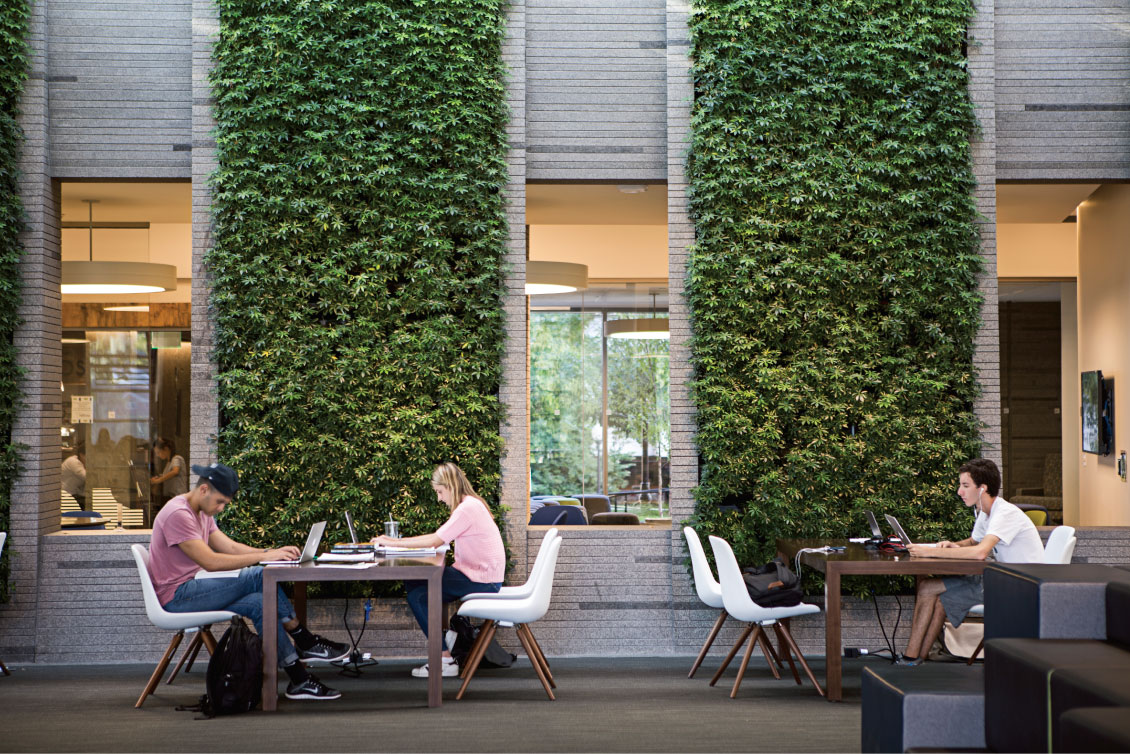
“The individuals who want something to happen on their campus, they wield the power of the students,” says Van Mourik. “If their colleagues either won’t listen, or they’re stuck in their ways, they get students there to rally around it. This is a generation of change makers. They’re so sick and tired of hearing about doom and gloom. They want to change it. And that’s what we need. We need to harness the power and enthusiasm of this untapped resource on campus.”
“The credit should really all go to the students,” echoes Zanella-Litke. “They really keep us moving forward as institutions. They really care about these places. They’re not just trying to enact change for the sake of change.”
Students, Chapple confirms, push for green practices in order to improve their campuses. “They want to say, my university did this, and I’m very proud of them,” she says. But also, she adds, students are looking to find ways to improve the larger world, to fix the environmental problems that they are inheriting from previous generations. “Our students know that they’re the ones who are going to have to live with this,” she says. “And they know that they’re going to have to create the solutions going forward.”