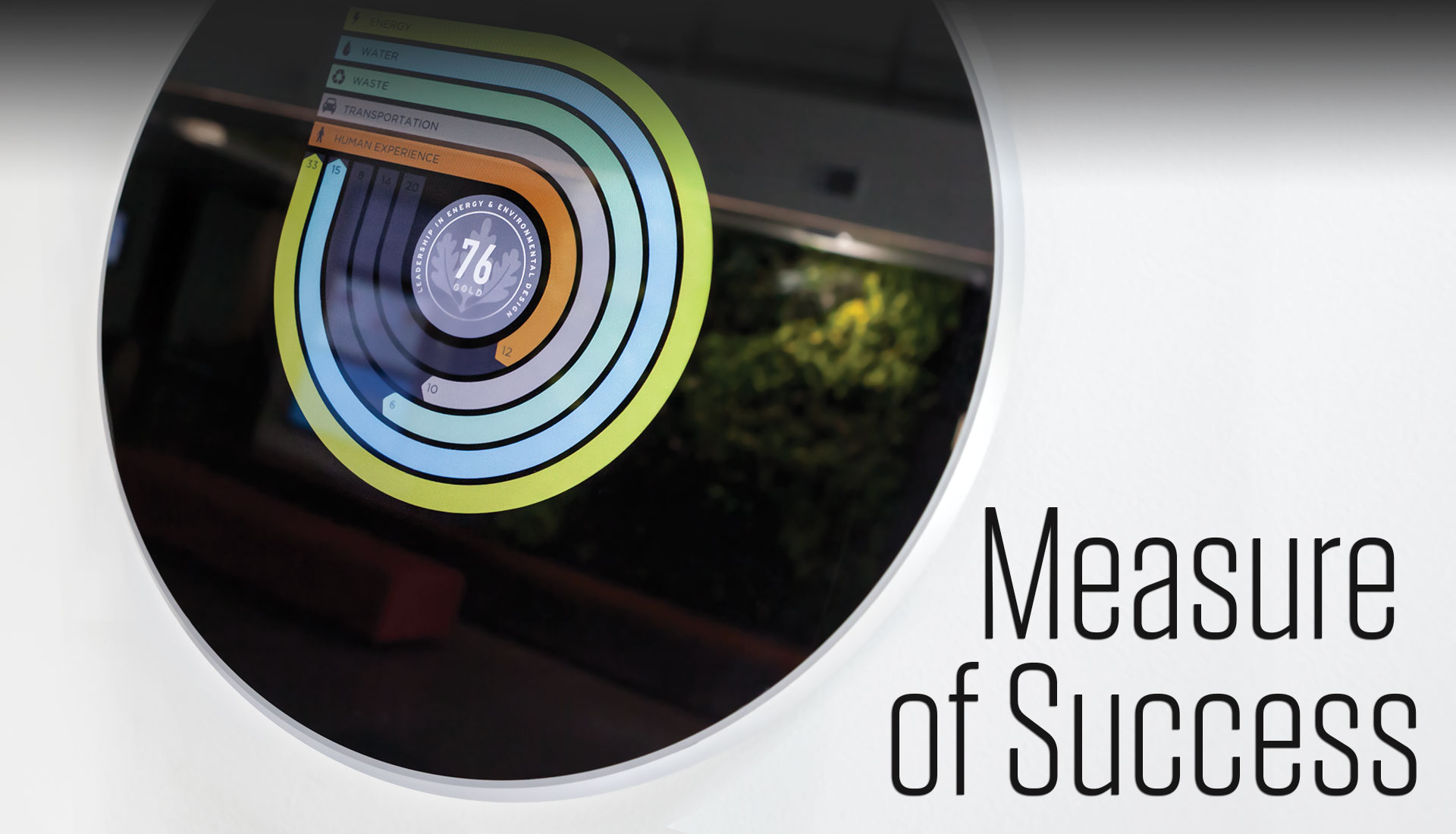
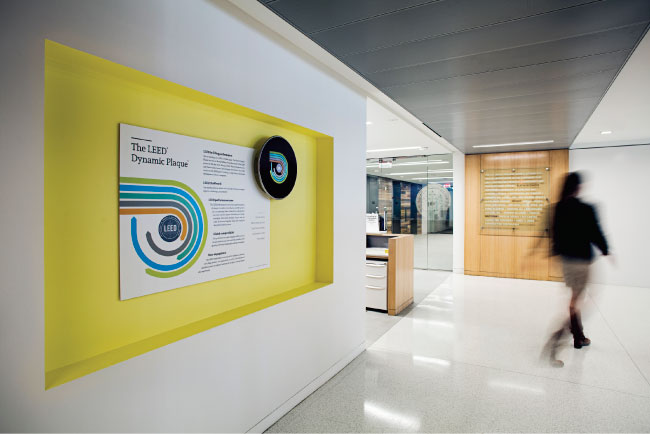
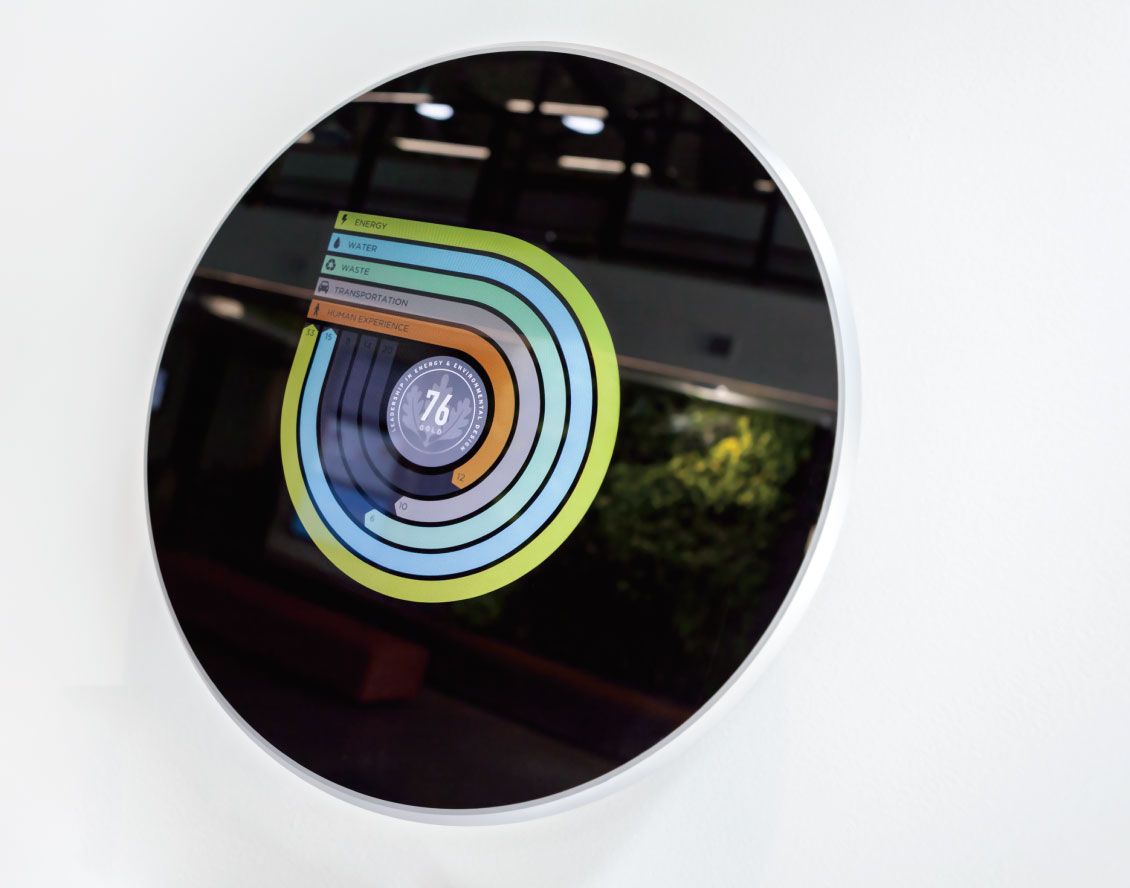
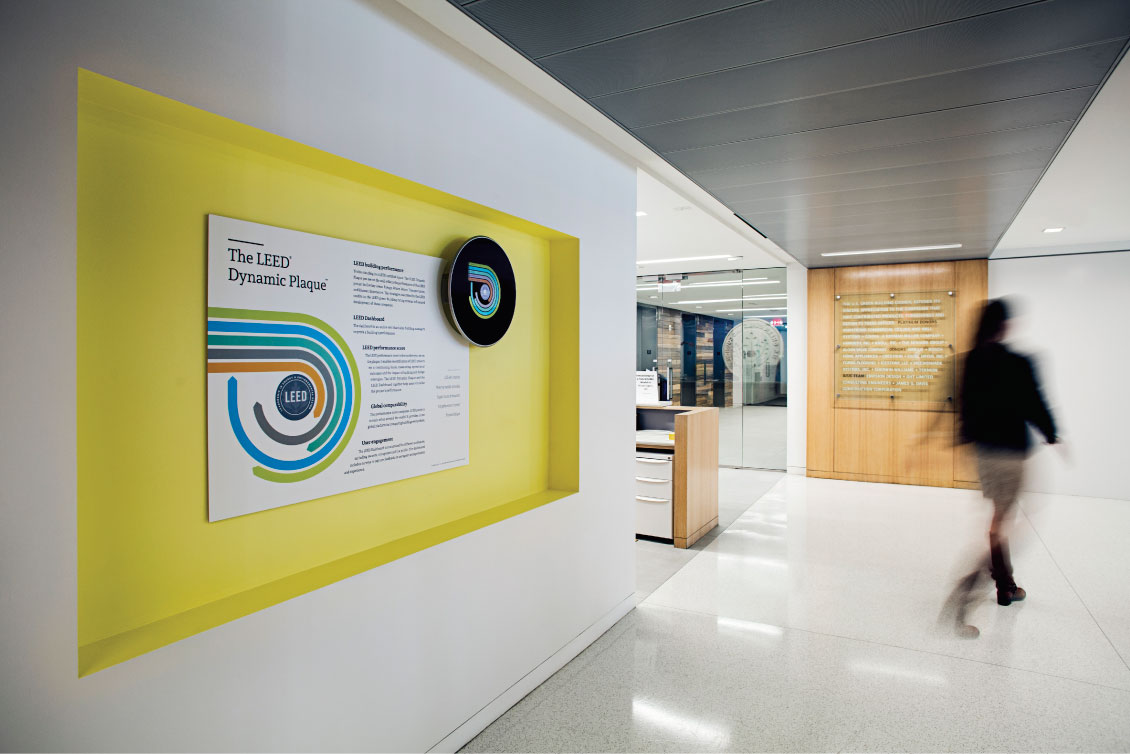
LEED Dynamic Plaques hang in two JBG properties, the National Cancer Institute in Rockville, Maryland, and U.S. Department of Transportation in Washington. “This was an option for us because we do have a goal of sustainable buildings across the portfolio,” Long says.
Mika Kania knows the power of the LEED Dynamic Plaque, simply by keeping an eye on the one hanging in USGBC’s front lobby: the first one ever installed. “Having the physical display in a lobby when they’re entering a building and seeing it every day, people notice whether the performance score has gone up or down,” Kania says. “It’s meant to create occupant engagement.” She recalls a time last year, when USGBC’s LEED Dynamic Plaque dipped to Gold from Platinum after a waste audit. “People started to notice, and wondered why the score had changed and what we could do to get the numbers back,” she says. “Our facilities team made some extra signage next to garbage receptacles and composting bins. We saw an increase, and we were back up to Platinum.”

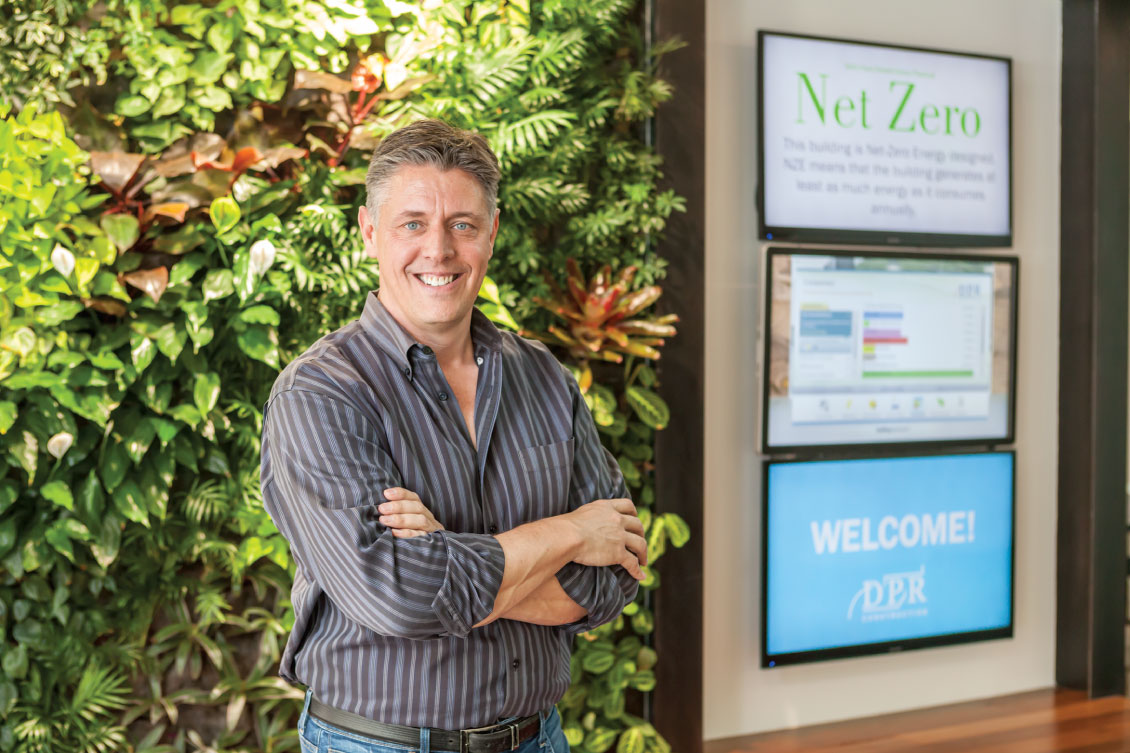
Ted van der Linden, director of sustainability at DPR. Photo: Emily Hagopian
For Renee Loveland, the sustainability manager for Gerding Edlen in Portland, Oregon, the LEED Dynamic Plaque is an easier and clearer way to access a structure’s environmental sustainability than the traditional LEED recertification process. Gerding Edlen, which specializes in real estate investment and development focused on sustainable properties, has 65 LEED projects in its portfolio. The LEED Dynamic Plaque hangs in one of those properties, the historic Dexter Horton building in Seattle, which is currently reading Gold. Using the LEED Dynamic Plaque to track the building’s real-time performance, Loveland says, “makes it a simple conversation.”
“It can be onerous to track and gather all the data,” Loveland says of traditional LEED for Existing Buildings (LEED EB) certification. “The LEED Dynamic Plaque is very performance based. It doesn’t consist of a lot of paperwork. It’s more focused on the results you’re getting.”
The fact that the occupants of the Dexter Horton building can see the results on the LEED Dynamic Plaque is exciting for Gerding Edlen, Loveland says. “They can use their smartphone to track the performance data. We’re excited the LEED Dynamic Plaque allows us to show our tenants that their daily actions really do affect building performance and that they have a direct role in the certification outcome.”
The Paharpur Business Centre (PBC) in New Delhi, India, a LEED Platinum building, has set sustainability as a bottom-line expectation. “Green building is like a high school degree; you have to have it,” says CEO Kamal Meattle. “The LEED Dynamic Plaque allows every organization to keep its sustainability goals focused on a continual real-time basis and not merely resting on the laurels of a one-time green certification. It surely is about staying relevant at all times. PBC has always believed that sustainable business is sensible business.”
The PBC experience gets to the heart of the LEED Dynamic Plaque. “It makes a building whole,” Horst says. “Making it whole means you can’t separate the landlord from the tenant and expect things to work. You can’t separate the designer from the manager.” Everyone has a part to play.
The resulting sense of pride and engagement in a workplace is a very real extension of the LEED Dynamic Plaque. For some, it becomes personal. Dhruv Gami recalls Horst approaching him about developing the LEED Dynamic Plaque. “Obviously, to make his vision a reality, it was clear technology would play a pretty significant role,” Gami says.
Gami recalls, chuckling, that he and his team started on a different plane than Horst. “It took me quite a while to realize how big Scot’s thinking was,” Gami says. “He was visualizing and thinking blue sky. We were thinking, what can we do with all of this? How do we make it move the needle without a lot of complex work? What can we do to leverage pieces that already exist, like water meters?” Gami and his staff did their part to devise a seamless system architecture that, with the eye-catching display, leverages a solid existing technology platform.
“I’m supremely proud of what we accomplished,” Gami says. “I’m so excited about it. I feel like a lot of new parents who show pictures of their new babies. I pull out a picture of the LEED Dynamic Plaque and tell them how much I love it.”
Since its introduction at Greenbuild, held in San Francisco in 2012, the LEED Dynamic Plaque continues to forge new ways of thinking that started with LEED. “We have design principles,” Horst says. “One, my favorite, is to ‘make the invisible actionable.’ Everyone’s thinking, how do we engage occupants in a building? The LEED Dynamic Plaque shows them when they’re doing worse and when they’re improving, and that engages them.”
Highly technological yet so outwardly simple, the LEED Dynamic Plaque is joining a legion of products whose value couldn’t be fully appreciated until they were experienced. Today, the early adopters of the LEED Dynamic Plaque, and the growing number of workplaces around the world that are following suit, are pushing the LEED Dynamic Plaque toward a new standard. Did anyone consider how great it would be to have a car that didn’t require manually cranking the motor until they heard of it and then tried it?
Gautami Palanki, USGBC senior consultant, building performance, and a trained architect, explains the evolution of the concept to reality by relating a comment by a designer whose company has two LEED Dynamic Plaques in its offices: “For the industry, this is the next best thing to sliced bread.”